Showing posts with label Costa Rica. Show all posts

March 24, 2021

Having Hope In Adversity

Talk presented March 7, 2020, in Joplin Stake Conference:

Life is beautiful … Life is amazing … Life is hard … Life is Challenging …

Life can be a really tough row to hoe!

Priesthood leaders on the Stake sugar beet farm
in Granger posing with their work hoes, including
Bro. Peterson, second from left; Dwayne Johnson;
and Gordon Evans, second from right. 
 
There’s adversity of numerous kinds – including genetical, physical and emotional ones. There are ones caused by the actions or decisions made by others -- or even those brought upon ourselves by our own choices.

When I was in my early teens, we were often called to work on our stake welfare farms, including planting tomatoes, harvesting tomatoes and picking corn. The hardest assignment was weeding the sugar beets.


How many have had that great opportunity?

How many have ever seen a sugar beet?

John Havlicek of
the Boston Celtics
from 1962 to 1978.
I could do about three rows, each about 100 yards long, before my back and arm were aching, and I was drenched in sweat. Those types of activities made me realize I shouldn’t make a career out of manual labor.

When I was in 8th grade, my father had a personal chat with me about my future career plans. I told him I was going to be a professional basketball player. I pictured myself as the next John Havlicek of the Boston Celtics.

Mario Lanza,
1921-1959
He then asked what I would do if I couldn’t be a pro player. What was my backup plan? I quickly said I’d be a professional singer, maybe like Mario Lanza. 

The same year I was
on West Lake Junior
High basketball team,
I was named the
"Most Fit" in
Coach Newton's
gym classes.
Then he asked: What then, if that doesn’t work out? I wrestled with my thoughts for a bit, then suggested I would become a writer or journalist – despite the fact my spelling and grammar were terrible. I figured I’d have an editor to fix those things.

After a lot of practice and overcoming many injuries, my basketball career reached all the way up to – the last spot on the bench of our junior high basketball team. 

And the pinnacle of my singing career was – high school madrigals and Concert Choir. I had a great time in both

Granger High School Madrigals
1967-68. I'm on the 2nd row, far right.
pursuits, but those career dreams were dashed. Still, I was confident my Father in Heaven would help me find something else.

That something else was a career in writing and journalism, starting with our high school newspaper, then as church mission public relations director, and then as an editor of the BYU newspaper, which led to a 35-year career as an editor at the daily newspaper, The Deseret News.

Sounds simple enough, but actually that path was filled with challenges and adversity!

Elder Neal A. Maxwell once said: “One’s life . . . cannot be both faith-filled and stress-free. . . . Therefore, how can you and I really expect to glide naively through life, as if to say, ”Lord, give me experience – but not grief, not sorrow, not pain, not opposition, not betrayal, and certainly not to be forsaken. Keep from me, Lord, all those experiences which made Thee what Thou art! Then let me come and dwell with Thee and fully share Thy joy!” (end quote)

The Lord knows we need to experience the bad and the good in life as we climb that figurative ladder back to him.

Growing up, I had real trouble with my shoulders – which led to surgeries on both. But those setbacks didn’t stop me from playing basketball as much as time would permit.

The large rock nicked my left-leg calf muscle, which
put my leg into spasms and I was helped down!
And at a Scout camp, I was almost killed when a large boulder came crashing down the mountainside, and I stood there frozen. In a split second, my brother pushed me out of the way. I was nicked in the left-leg calf muscle, but was alive! The rock, however, plummeted down the mountainside and killed a member of our troop. We were devastated.

Elder Adhemar Damiani of the Seventy has said: “As part of our mortal probation, we pass through affliction, pain, and disappointment. Only in Jesus Christ can we find peace. … His gospel gives us the strength and the eternal perspective to face what is coming with good cheer.” (end quote)

Elder Hunt on crutches and
left leg in full cast at San
Jose, Costa Rica, 
airport set
to fly home to Granger.
The words, eternal perspective, played a critical part in the challenge I faced when I was 20 years old, more than half a century ago, and serving a mission in Costa Rica. After several months of pain in my left leg and two surgeries, the doctors discovered I had bone cancer. One day later, I was on my way back home to Utah where I was told that the only way to maybe beat the cancer was to have my left leg amputated. Remember, this was before chemo and radiation therapy.

Two things happened to turn my hope into faith. The night before the surgery, I prayed long and hard about my future. Was I going to survive? And if I survived, could I make it without basketball and as an amputee?  Finally, I received a spiritual assurance that I had a good life ahead, even that I would eventually marry and have a family.

Elder Hunt standing in front of Pres. Milton E. Smith,
left, and Elder Delbert L. Stapley of the Quorum of
Twelve, and other missionaries in the San Jose area. 
Then, a couple of days following the surgery, I received a blessing from Elder Delbert L. Stapley, who I had previously met when he visited our mission in Costa Rica. His blessing was amazing: He first spoke with God and explained to Him my situation. Then, after a pause, he proceeded to bless me. Part of that blessing was a command that if there was any cancer left in my body that it would leave and never return.

Five years later, the doctor who had performed the surgery, said he really hadn’t expected me to survive. He credited Elder Stapley’s blessing for the miracle.

I soon was back in school at BYU and receiving assistance from the Utah Division of Rehabilitation, which made it possible for me to go on and earn my college diploma.

I was blessed in many ways, but those college years and the ensuing couple of years were really tough, emotionally. My self-esteem suffered, and I started my career at Deseret News emotionally and spiritually low. What saved me was realizing that I could actually change and repent. That I could break the chains Satan had wrapped around me.


That spiritual reawakening came while reading Pres. Kimball’s book “The Miracle of Foregiveness” – that, along with getting involved in Young Adults, which is where I met Nancy. She was the one who helped me through the repentance process. Finally I had hope again – I had regained my eternal perspective.

The Lord makes no secret that He will test our faith and our obedience. “We will prove them herewith,” He said, “to see if they will do all things whatsoever the Lord their God shall command them.”

Elder Dallin H. Oaks has said: “Most of us experience some measure of what the scriptures call ‘the furnace of affliction.’ Some are submerged in service to a disadvantaged family member. Others suffer the death of a loved one or the loss or postponement of a righteous goal like marriage or childbearing. Still others struggle with personal impairments or with feelings of rejection, inadequacy, or depression.

Pres. Dallin H. Oaks
[But] Through the justice and mercy of a loving Father in Heaven, the refinement and sanctification possible through such experiences can help us achieve what God desires us to become....

Father Lehi promised his son Jacob that God would ‘consecrate [his] afflictions for [his] gain.’

The Prophet Joseph was promised that ‘thine adversity and thine afflictions shall be but a small moment; and then, if thou endure it well, God shall exalt thee on high.’ (end quote)

Joseph Smith Jr.

Enduring well means living faithfully despite our trials and misfortune. It means learning from these trials and experiences and thus becoming more like our Father in Heaven.

Eternal perspective allows us to understand that if we endure well these things and learn from them, then we can look forward to living with our Father in Heaven – and even eventually living the kind of life that God lives! That’s a pretty awesome promise!
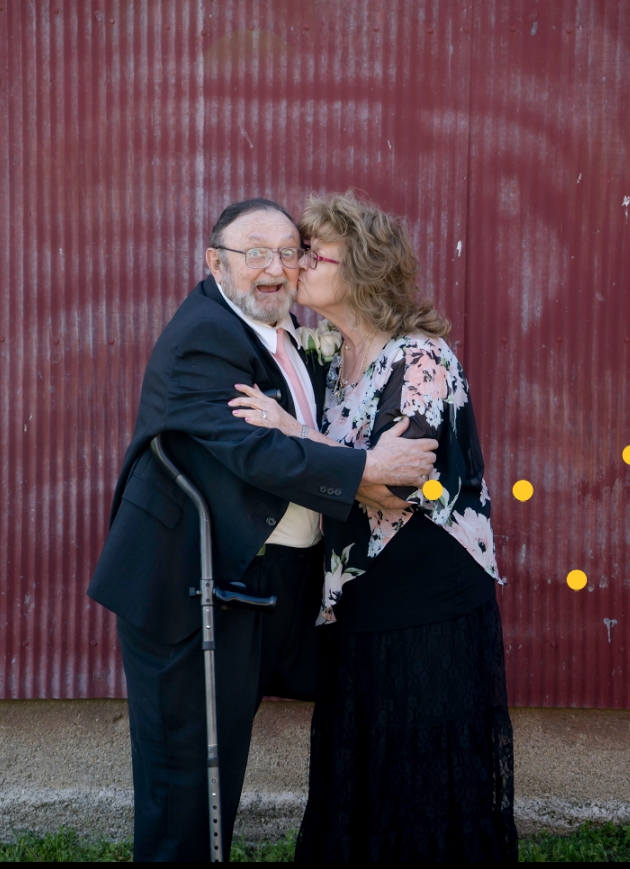
Lee & Nancy Hunt

Now, more than 60 years since that blessing from Elder Stapley, I’m still hanging on – married to my sweet Nancy for nearly 45 years, and treasuring my five children and 17 grandchildren. But I still have daily afflictions and challenges.

So, I pray that we will hold on through our trials, become closer to our Father in Heaven as we do so, and hold tight to our eternal perspective, in the name of Jesus Christ, Amen.

These quotes I wasn’t able to use due to time constraints, but well worth review on the subject:

Pres. Russell M. Nelson
Pres. Russell M. Nelson has said: “True repentance is not an event. It is a never-ending privilege. It is fundamental to progression….” (end quote)

Why does our Father in Heaven allow these burdens?

Wouldn’t it be nice to not have any? Life would be so easy – but would we learn anything if life was all bliss?

Is there a reason for life’s adversities?

Elder Quentin L. Cook

Elder Quentin L. Cook has said: “Adversity should not be viewed as either disfavor from the Lord or a withdrawal of His blessings. Opposition in all things is part of the refiner’s fire to prepare us for an eternal celestial destiny.” (end quote)

And many of these adversities and afflictions require us to turn away from sin and despair and take hold of Christ’s Atoning Sacrifice through repentance.

Elder Bruce C. Hafen
Elder Bruce C. Hafen has said: “The great Mediator asks for our repentance not because we must ‘repay’ him in exchange for his paying our debt to justice, but because repentance initiates a developmental process that, with the Savior’s help, leads us along the path to a saintly character.” (end quote)

Pres. Russell M. Nelson has said: “True repentance is not an event. It is a never-ending privilege. It is fundamental to progression….” (end quote)

Elder Dieter F. Uchtdorf testified: “… that when we

Elder Dieter F. Uchtdorf

embark upon or continue the incredible journey that leads to God, our lives will be better. This does not mean that our lives will be free from sorrow. We all know of faithful followers of Christ who suffer tragedy and injustice–Jesus Christ Himself suffered more than anyone.... In fact, sometimes it seems that our lives are more difficult because we are trying to live our faith. Following the Savior will not remove all of your trials. However, it will remove the barriers between you and the help your Heavenly Father wants to give you.” (end quote)

Elder M. Russell Ballard
Elder M. Russell Ballard has said: “No matter how difficult the trail, and regardless of how heavy our load, we can take comfort in knowing that others before us have borne life’s most grievous trials and tragedies by looking to heaven for peace, comfort, and hopeful assurance. We can know as they knew that God is our Father, that He cares about us individually and collectively, and that as long as we continue to exercise our faith and trust in Him, there is nothing to fear in the journey.” (end quote)

I’ve always loved the Book of Mormon story of Alma and his people who fled into the wilderness and were eventually captured by the Lamanites and forced to labor for them. But the Lord, instead of immediately rescuing them from the Lamanites, he first helped them handle their burdens:

 In Mosiah, Chapter 12, verse 15: And now it came to pass that the burdens which were laid upon Alma and his brethren were made light; yea, the Lord did strengthen them that they could bear up their burdens with ease, and they did submit cheerfully and with patience to all the will of the Lord.”
Elder D. Todd
Christofferson
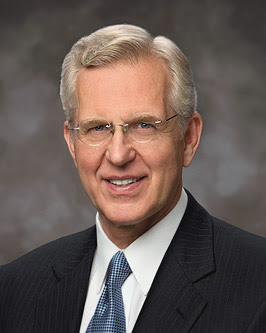
Elder D. Todd Christofferson has said: “Exercising agency in a setting that sometimes includes opposition and hardship is what makes life more than a simple multiple-choice test. God is interested in what we are becoming as a result of our choices. He is not satisfied if our exercise of moral agency is simply a robotic effort at keeping some rules. Our Savior wants us to become something, not just do some things. He is endeavoring to make us independently strong …” (end quote)

November 22, 2020

Thankful for 1970 Priesthood Blessing

Facebook post Nov. 20, 2020

Elder Delbert L. Stapley,
holding a Costa Rica cart.
While listening to President Nelson, the prophet of The Church of Jesus Christ of Latter-day Saints, present his social media message on Gratitude, I considered all my blessings and felt the desire to share one that was bestowed upon me more than half a century ago.

I was diagnosed with bone cancer when I was twenty years old while serving a church mission in Costa Rica. I was quickly sent home to Salt Lake City where surgeons amputated my left leg high above the knee. Life expectancy for this type of cancer back in 1970 was very limited: There was no radiation treatments or chemotherapy -- just amputation and a prayer.
The night before the surgery, I prayed – again -- to my Father in Heaven about my situation and my life’s dreams. I prayed for strength to get through this painful, life-changing challenge. I prayed that with that strength I could be positive in my outlook and go on to college and, God willing, find a woman who could put up with me and be my companion and share our lives together. And, with that, I hoped to one day we would have children who we would love, cherish and teach life’s lessons.
After what I felt was a lot of soul-searching and pleading in that dark hospital room, a feeling of peace overcame me. I know the Lord was aware of me and that he was going to help me through this terrible ordeal. I felt I could go forward and have a life – though it would be far different from what I had expected just a few months before.
The post-surgery recovery was the absolute worst: The phantom pains were horrible. Slowly I started to improve – though the phantom pains have never completely left. And sometimes I get terrible flareups.
A few days after that surgery in September of 1970, I received a visit from Church President Joseph Fielding Smith, who was the father of my mission president, Milton E. Smith. President Smith and his wife buoyed my confidence. Then a day or two later, I received another special visit, this time Church Apostle Delbert L. Stapley, who I had met in Costa Rica while serving as the mission’s public relations elder.
He gave me an amazing blessing. As he laid his hands on my head, he spoke to Heavenly Father as one person speaks to another, explaining my situation to our Heavenly Father. Then he paused, and through the power of the priesthood which he held, he pronounced a blessing on my head. The part I remember most vividly was his command that if there was any of the cancer still in my body that it would leave and would never come back. The feeling during that blessing was powerful.
I knew then that his blessing was a confirmation of my peace of mind following my prayer before the surgery. I’ve held on to that over all the decades that followed. I’ve stumbled, fallen, sinned and repented and sinned way too many times. But still I know that the prayer that night and the subsequent blessing were real and everlasting.
Today, as Pres. Nelson has encouraged us to do, I offer my profound thanks to my Father in Heaven and to Elder Stapley for his blessing, which promised a miracle. In fact, five years after the amputation and at the point when the doctors say you’re finally through the woods, my surgeon admitted that as far as he was concerned, I was still alive because of that priesthood blessing. He said he didn’t honestly think I had a chance.
Looking back at my life, I’m eternally thankful for:
· These extra decades here on earth.
· Being able to graduate from BYU and get a job at Deseret News, which lasted for 35 years.
· My wife, Nancy, who I met in Young Adults after graduating from BYU. She has had to do so much extra being my wife. I love her eternally!
· My amazing children, Heather, Lena, Jason, Jared, Nathan -- and Justin, who we lost at birth and is in Heaven already.
I witness that our Father in Heaven keeps all his promises, and I’m so grateful that he does.

Post responses:

Carol Linton Lavigne Such a great story, and what a blessing sweet Nancy is! You’ve always been a wonderful friend and I’m so happy you’ve had a happy ending! 💕
Sharron James Thanks so much for sharing this wonderful story of Gratitude 😊❣️ Jeremy Swarnes Thanks for being YOU Lee!! Jeanette Waite Bennett I had never heard "the whole story" about your leg. Wow! That priesthood blessing was remarkable. What an amazing life you've had! I'm so glad I got to cross paths with you at the Deseret News. You were the best boss. Carlyn Jarvis Crockett What an amazing story!
Heather Wentz Thank you so much for sharing this! You are so amazing! I'm so grateful to be your daughter! Charles Taylor Thank You for sharing your story. Thankful you are still with us to share this wonderful testimony. Bruce Taggart Lee, thanks for sharing this tender experience. Larry Anderton Lee, thanks for sharing your story. i never knew the whole story, especially that it occurred during your mission. You are an inspiration to many and I'm glad to have known you for so long. Gary Beckstead This is a wonderful story of faith and the power of the Priesthood. Thanks for sharing this. Carolyn Dugdale You definitely one cool dude, proud to have you as a friend 😁 Trena Hunt I am glad that your my brother! Shirl Busick Thank you so much for sharing. You have helped me to renew my faith. Miss you guys. Debra Adams What a great testimony. I remember when you came home and you lost your leg. You have triumphed over such adversary conditions. May Heavenly Father continue to bless you!🎄 Sandra Argyle Westwood I've never heard this before, thank you for sharing. Grateful for your family. Whitney Bennion Thank you for sharing Lee! Hope you and your family are doing well! Tell them hi! Rhonda Hunt Johnson I love that you shared this! I knew it happened while you were in your mission, but I didn’t know you were in Costa Rica. This strengthens my testimony of the priesthood and know it’s real! I’ve been able to grow right along with this and I’ve always been amazed at your sense of humor and positive attitude. 💕

Kevin Westwood Thanks for sharing you're experiences! I have never heard this before! Very inspiring! William Kay Blackwell Amazing! Thanks Lee. You have always been exceptional.


August 21, 2012

Truth and Faith in Cancer Ordeal

This paper was an assignment for Professor Bradford's Sociology class, which was much like a religion class with a sociology basis.

Sociology Class Assignment, 1970

   On Sept. 1, 1970, I was laying in a hospital bed in Salt Lake City and thinking about life and the many things I had learned and experienced in my 20 years on Earth. On the next day, I was to go through an experience that would change my life in every way.

   As the staff wheeled me back into my room after a very  serious operation,  I  realized  that  if I could  see below my waist, I would find only one leg where there had been two only hours earlier.

What does a person think about when he knows he has cancer, when he knows he must lose one of his legs, when he knows there is a possibility that he will die?

   Only a week earlier, I was a patient in a different hospital in the little country of Costa Rica when the doctor and my mission president, Milton E. Smith, explained, through the sad silence, that I would be going home the next morning by  jet airline so the doctors back state-side could work on me.

   At that time, neither really explained the seriousness of the situation. But after I had arrived in Utah and the doctor who had been retained by the church had examined the X-ray, my knee and some tissue samples, he said – quite frankly – "You know we'll have to amputate your leg.” He also said that if the operation was success­ful, it would stop any cancer from spreading to other parts of my body by eliminating the part of the body in which it was growing.

   Three days elapsed before the operation while I, mentally and spiritually, sought the strength I would need.

   In prayer that first night, I called on God to please give me strength and understanding – and to help me through this challenging situation. To give me the faith I needed. This strength and help did come, while all those around me were happily surprised by my attitude and happy spirit.

   Following the operation, I realized that without the help of God, without the realization that God lives,   without the assurance that I will resurrect in a more perfect state, I think I would have cursed, life and   damned the Heavens, while sinking into a bottomless despair.

   This is the most important goal in our mortal life: "To know God and his Son Jesus Christ. I know that they live and that they love us and will help us if we will have faith in them. What a glorious thing it is to know that life does not end here on earth and that at the time of resurrection, I will once again be able to run and jump on two firm legs.

   During this trial, when the thoughts of a future death did come into my mind, I  felt that, though I had lived only 20 years, I had accomplished things  and  done things that made me feel as though 1 had had a complete life. (I was probably very wrong, but that is how I felt.)

   Don't think I felt I had conquered all evil, because I hadn't nor have I yet. But I did feel calm. The one thing I knew I lacked was to be married in the Temple of the Lord.

   I also felt happy that I didn’t wait until I was older to become active in everything but that I had been   constantly active in doing things, what I felt were worthwhile.

   Also, I had been on a mission and had felt that joy that comes to a person when he sees one, to whom he has brought the message of the restored gospel, excel in his life.

   If I were to name the most important values in life, I would point to God and to a Christ-like life to be the goal in one’s life while always doing those things that are good and helping others try to reach that same goal.

August 19, 2012

The Inevitable

     When I wrote this short story, back in 1972, I used a lot of my experiences and memories.
The ending is one of the logical outcomes that I envisioned for myself.

The Inevitable

     At seven o'clock, the LDS Hospital nurse tells the couple they can go in.

     Darrell, maybe 27 years old and about six feet tall, is a husky construction worker whose firm powerful hands, tanned to a smooth brown during long hours working under the sun, tightly holds his wife’s small, delicate hand.

     As they pass the nurses counter, the young mother of three quietly murmurs, "Why?"

     Shelley, who has dark brown hair that is set in large sagging curls, normally has a smile and sweet words for everyone. Today she’s just somber.

     Looking up at Darrell, her watery blue eyes meet his.

     Approaching room 309, they hesitate, glance at each other and then push open the large, wooden door and enter.

     The small room has a large, metal-framed bed in the middle. To the left, the August sun shines through a narrow oblong window as the wind whips a lose screen against the pane.

     The walls are a barren white. There’s a half-empty cup of water and a water pitcher on a small table to the left of the bed. White sheets cover all but the face and arm of the young man lying quietly in the large bed.

     As the couple enters, the young man smiles and, for a moment, he seems well – except for his chalk-white face.

     "It's about time. I was beginning to wonder," Mike Norton says in greeting his visitors.

     "The nurse wouldn't let us in," Darrell answers.

     "She sure is good looking," Mike says. I asked her to marry me and my wooden leg when I get out of here."

     "What . . . what did she say," Darrell hesitantly asks.

     "What they all say when I'm joking – sure," Mike laughs.

     He must have laughed too hard because he begins coughing.

     Catching his breath for a moment, "Those white blood cells are really battling." Then he coughs again and again.

     Darrell and Shelley move closer. Mike reaches out and grabs Darrell’s hand, and Darrell holds tight.

     Mike, Darrell's younger brother, is short and was once a little chubby with fleshy cheeks that made him look a lot like a chipmunk. Now, his cheeks are gaunt and pale. His hazel eyes, though circled by storm clouds, still have a sparkle.

     Mike has lost ten pounds since entering the hospital three days earlier. He mentions it to his brother, then adds: "When I was in the hospital back in ‘70, I lost about 25 pounds – in two hours!" As he speaks, he pats the empty space where his left leg should have been.

     Mike looks at his sister-in-law, and Shelley forces a smile.

     Forty-five minutes slowly pass, punctuated by long stretches of silence, as they chat about the past – mostly about Mike and Darrell’s hunting trips with their father.

     When Patricia, Mike’s young blonde nurse, enters carrying a syringe, Mike moans: "Not again!"

     "Again," Patricia says. "Where this time?"

     Mike points to his right thigh.

     As Patricia moves closer, he adds, "I bet it's morphine. I'll be a drug addict when I get out of here."

     Patricia says nothing as she drives the needle into Mike’s thigh, injects the drug, removes the syringe and quickly leaves the room.

     Five minutes later, the drug begins its work.

     "Just what I need, sleep! Here we have a few minutes, Mike says, and I can't keep my eyes open."

     "Go ahead and sleep. We'll stay as long as we can," Shelley says.

     Darrell, now sitting in a chair up close to Mike’s bed, holds tight to Mike's hand as his little brother seems to sleep. Darrell and Shelley exchange glances as Shelley takes a seat in the corner of the room.

     "I can't believe it," Mike thinks, "Why me? Where -- how did it begin? Remember . . . .

     "President, got a minute?” Mike asks as he leans on the door frame leading into President Smith’s mission office in San Jose, Costa Rica.

      “Sure,” President Smith answers as he beckons Elder Norton into his office.

     “It's my leg,” Mike tells his mission president. It isn't any better. I can hardly stand on it. Do you think I should go see a doctor? I’m thinking it might be a re-injury to my knee that I banged up in a snow-tubing accident about three years ago.”

     “Maybe you ought to, Elder. You’ve been hobbling around for way too long. Go see a doctor as soon as you can get an appointment. You need to get back to your missionary work."

     "July 7, 1970, was the first operation," Mike remembers.

     "You'll be out of here in a couple of days," encourages Dr. Steinworth, Mike's Costa Rican German doctor. Dr. Steinworth received his medical degrees in the United States before setting up his practice as a bone specialist in his native San Jose.

     "I'll never figure out what made me go to a bone doctor,” Mike half thinks, half dreams. “Usually any doctor would have been all right.”

     For a moment, Mike’s back in his LDS Hospital room with Darrell and Shelley where all that breaks the silence is the beeping monitor behind Mike’s head – that, and an occasional slight bang as the loose screen slaps against the window pane.

     Through the still, Darrell keeps a firm grip on Mike's hand.

     Quickly, Mike’s mind is back in Costa Rica and the memories of his last two months there in San Jose.

     "'Oh it hurts –I can't stand it,” Mike remembers himself yelling at one point in his post-surgery “recovery.”

     “You won't believe it,” he recalls writing in his diary. “I stayed in the hospital for a week after the first operation when they removed a broken cartilage – from that tubing accident – and three weeks later, July 29, I was back in again. What luck!

     “Elder Galan, my companion at the time, got a call and needed to go meet someone downtown. I didn't want him to go alone, so I limped along leaning on a cane. My hand went numb.

      “After getting off the bus at the downtown plaza, we had to cross a street, which was maybe 30 yards wide. The light was in our favor, but it also favored the guy in the Jeep Land Rover, who sped around the corner, heading straight at us. Elder Galan jumped out of the way, but when I tried, I twisted up my bad left leg. I ended up with my hands on the front of the Rover. The pain in my knee shot through me, and I began to fall apart. The driver of the Rover took me to the hospital – all the while listing to me moaning and crying like a baby. It was the worst pain I think I've ever experienced. Finally after arriving at the hospital and waiting what seemed like hours, someone gave me a pain injection and it quickly began to do its job. Then, after rolling me all over the corridors in a wheelchair, I ended up on the X-ray table."

     "My old friend the X-ray table," Mike says, startling Darrell.

     "What about the X-ray table," Darrell asks.

     "Ah, nothing,” Mike mumbles. “I was just thinking." Mike quickly falls back into his memories.

     "Dr. Steinworth finally came, and I just held tight to his arm. Three days later, they released me and I spent a week laying around at Dona Marta’s home. What a nice lady – fed me in bed."

     "That was the last entry I made in my missionary journal," Mike recalls.

     "You'll have to leave now," Patricia tells Mike’s visitors as she enters with a new pitcher of ice water.

     "He's sleeping," Darrell quietly tells the nurse.

     "You better leave. You should be able to see him tomorrow," Patricia suggests.

     Darrell releases his grip for the first time and quietly walks out with Shelley. Patricia sets the ice water pitcher on the tray next to Mike's bed. She then notices him looking up at her.

     "You weren't asleep," she asks, already knowing the answer.

     She stands at his side with her fingers curled around the bed rail, pausing for a moment in thought.

     "When did you know you had cancer," her eyes ask? But without asking or getting an answer, she turns and walks out.

     "When was it," Mike asks himself. "The third time I went into the hospital in San Jose – or was it later?"

     Mike remembers Dr. Steinworth saying, "I think it's either infection or some form of cancer — benign or malignant. You'll have to be admitted today so we can find out for sure.”

     Mike beckons back the memory and even the date, Aug. 22, 1970, when President Smith and Dr. Steinworth came into his San Jose hospital room. It was three days after the exploratory surgery to determine whether the cancer was malignant. From the look on their faces, it wasn’t Christmastime.

     “We're going to fly you home tomorrow so the doctors in Salt Lake can take care of you,” President Smith told Mike. The next day he was headed home.

     “Let me remove those two arm rests between the seats so you can stretch out," said the slender airline hostess with a permanent smile as Mike hobbled down the aisle aboard the airliner that took him on the second leg of the trip – from Miami to Chicago – of a 12-hour flight from San Jose to Salt Lake City.

     "The moment I really knew and accepted that it was cancer was in Dr. Olsen’s Salt Lake office. The date was the 28th of August."

     "'We'll have to remove your leg above the knee," Dr. Olsen explained to Mike. We want to make sure we get it all.”

     “I cried, I really cried then,” Mike remembers – but mostly when no one was around.

     “All the crying stopped,” Mike recalls, “after the conversation I had with the Lord the night before the amputation. About 11:30 p.m., the hospital was resting, the room was dark and no one could hear as I began a prayer – a vocal prayer. Across the room was an old man who was snoring up a storm and who really couldn’t hear anything if he had been awake.

     “I talked with my Lord: 'I don't know why this is all happening to me, Father, I'm really not worrying about that. But I need help — I really need it. I can't hack it alone. This thing I can't do myself. I love playing basketball and dancing and hiking.’

     "What will I do? I want to be normal. I want to love. I want to find a girl that loves me. I can't die, yet, I haven't married yet. I've really had a great life, but I’m only 20 years old and, Lord, I want to do more. I need thy help – I need it.’

     "I had never felt anything so strong as I did after that prayer," Mike remembers. “I was given an answer – and the strength to go on.

     “Whether I lived a long full life or not didn’t matter as much as knowing that there is a loving Father in Heaven and life after this one. I knew I would be whole once again – and maybe even be able to play some basketball there.”

     "September 1, 1970, I was wheeled back into my hospital room – one leg less," Mike thought back. For a few days I was really sick, and then everything went much smoother. The doctors and nurses even got mad at me for being so jovial."

     The next milestone came a few weeks after being released from the hospital following the amputation: "Look, I've got my new leg!” Mike announced to his family after returning from Intermountain Limb and Brace Co.

     “I'll dance again,' he added. It was the sixth day of the first month of the New Year.

     “Are you going back to school?” asked a friend soon after Mike began using canes instead of crutches with his artificial leg.

     “I'll start in about two weeks – January 20th, to be exact," Mike boasted.

     Mike, torn away from his memories and back into the present, coughs uncontrollably. As he reaches for the buzzer, he wheezes in a breath. The room is dark except for the light from a small lamp to the right of his bed.

     “Four years of college in three years. Not bad for a guy who can only cough and wheeze now," Mike says as Patricia comes in.

     "Here, let me help you," she says, wiping his chin.

     Mike coughs again, and she wipes his chin again.

     "On a scale of one to 10," she asks him?

     He mumbles: “Nine point five.”

     Finally, the coughing eases and Mike relaxes. "Why did it come back after the amputation?" Mike asks himself.

     Opening his water-glazed eyes, he looks at the blood serum dripping from a clear plastic bag into the plastic, narrow tube that leads to his arm. His heavy eyelids involuntarily close.

     "I wonder what its like?"

     Mike imagines his weary eyes opening again, "What time is it," he faintly asks?

     He doesn't hear the reply – he’s off again into the past.

     "I remember the time I scored 26 points playing on our church basketball team. What moves I had!"

     Tears slowly form at the corner of his eyes, then roll down his cheeks.

     "Lord!"

     Mike, for the first time, becomes conscious of the slow thump of his heart.

     "Tha-thump. Tha-thump. Tha-thump."

     "Everything is all right," he says to himself.

     His listless eyes open slightly. There are people standing next to his bed, but who are they?

     "Hi," he tries to say. Nothing comes out but a soft moan.

     All he can hear is his heart:

     "Tha-thump. Tha-thump. Tha- . . . .


W. Lee Hunt, Aug. 23, 20122: As part of the assignment to write a fictional story for my college English class, I had to write a critique of the story as well.
Not only is it interesting to read this fictional version of my cancer ordeal forty years after the fact, but even more so to read my own critique of the story.

Critique of “The Inevitable”
December of 1972
The goal in writing this short story was to help others better understand how I feel when I think about my life and about death.
The story was written to convey an emotion, possibly mixed emotions. What emotion? It’s hard to explain, but not so hard to write about it and let others explain to me.
It was written to tell my story. Of course the ending is fictitious but is still the most important part of the story.
There are three reasons why I had Mike die at the end:
First: I didn't want to do the story in a strict chronological order – from the beginning to his death – but to start at his death bed and go back to the be¬ginning, then return to his death bed, then go back into the past again, and again return to the death bed until the past was the present. I felt that the death bed could be the best revolving door to the time changes. I felt this part was a strong point of my story: the time changes.
Having the death bed as the revolving door to the time changes allowed me to remind the reader that Mike was dying as the reader examined the past events in Mike’s life, thus giving them the ability to see what was happening while knowing the end result.
Secondly: Having him die allowed the reader to see the past in the eyes of death. I accomplished this goal quite adequately.
Thirdly, I felt that it would mean more to the story if the young, returned missionary died – a note of irony to show his faith when, that which killed him, he received on his mission.
The story could have been written in first person, but too many things that I wanted to do would have been lost. The most important difference would be that if it was written in first person, the reader would be less sympathetic toward the writer who was telling his own sad story. In third person, I was able to step one step back and tell the story -- allowing the reader to be more sympathetic toward the main character.
The story written in third person allowed the reader to see more of the actions of those around him and outside of the room and even look at himself.
Writing in the omniscient form as pertaining to the main character, allowed the writer to do two things:
First, go back in the past through Mike’s present thinking, seeing what he thought and what had happened. I felt I accomplished what I wanted in this area.
Secondly, the goal of showing the feelings and emotions could really come out when the readers could read for themselves what Mike was thinking.
There were two conflicts: conflict between life and death, and conflict between ideal of the young man living out a good and happy life and his dying – or reality.
I feel I was successful in what I wanted to accomplish in this story.